Project
Coverti – Access to information in repressive regimes
ACCESS TO INFORMATION
IN REPRESSIVE REGIMES
In repressive regimes, the first obstacle between a journalist and the truth is not technology, it is trust. For people living under surveillance, every message can carry danger. High-security tools can make things worse: their unfamiliar interfaces and encrypted warnings can trigger fear, suspicion, or the sense that something “secretive” is happening. Most sources feel safer on the platforms they already use every day – WhatsApp, Telegram, Instagram – yet these spaces offer little real protection.
Journalists are caught between wanting to safeguard their sources and respecting the reality of what those sources find usable, familiar, and emotionally safe. Before any information can be exchanged, journalists face a delicate challenge: proving their identity without revealing too much, building credibility without overwhelming someone already afraid, and establishing a human connection strong enough to outweigh the risks. No matter the story, no matter the technology, everything begins with a fragile moment of trust and in many cases, that moment determines whether the story can exist at all.
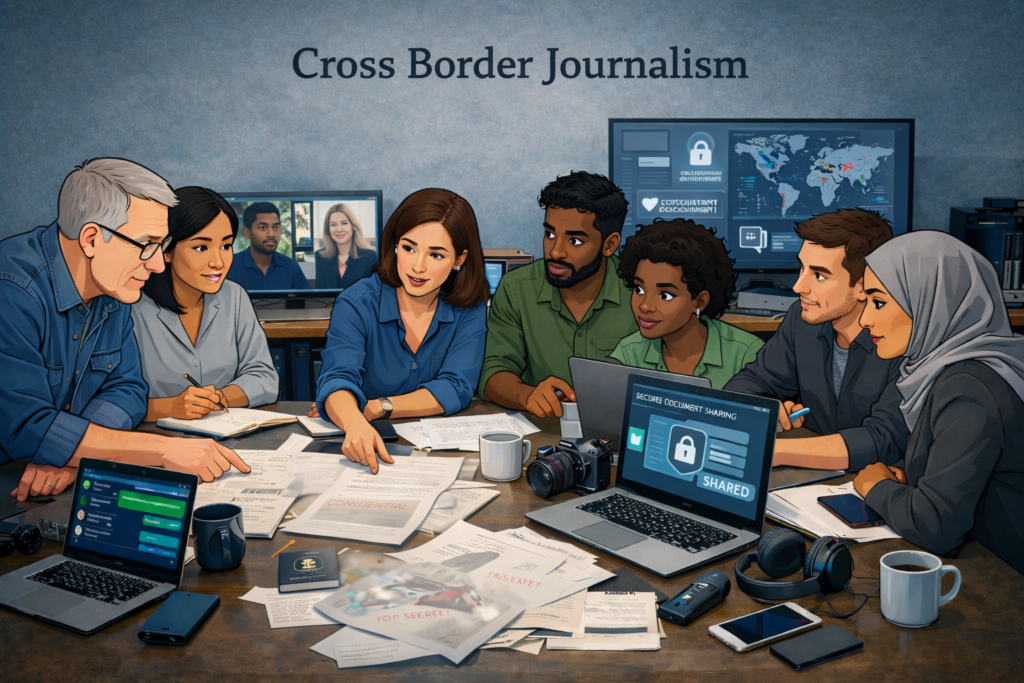
Through our partnership with VPRO, our project team has a goal to design a platform that can make this relationship between journalists and people from repressive regimes stronger and more collaborative in a way that creates authentic stories that carry impact to audiences.
Our team is composed of people with various backgrounds and expertise:
Anna Charron – Cultural Sociology & Social /Urban Design
Sherifat Oshoala-Lamina – Communications
Haru Kitaura – Social / Service Design
Elahe Rezapour – Digital Design
Shiva Ganesan – Finance/Business management
The 5 of us, together with our Creative Project Manager Andrea Bijen, and our partners at VPRO are working toward a more ethical, human-centered approach to international reporting. Our project explores how journalists can build safer, more trusting connections with sources and mediators living under repressive regimes, and how public broadcasting can evolve into a more collaborative ecosystem. Read on to see how our research, insights, and prototypes have taken shape.
Here is our video. Please check it with contents!